
Organizations are complex – they’re made up of people, relationships, and power dynamics. They exist within markets, supply chains, and communities. At the Psychological Safety Institute, we’re interested in this entire operating environment; all the interconnected factors that shape how work gets done.
The Psychological Safety Ecosystem turns that complexity into something practical. It shows how psychological safety operates across multiple contexts – from each individual employee’s mindset through to industry-wide norms and standards.
This article walks you through the framework, and shows how it helps you redesign your business. For leaders ready to fix dysfunction and level up performance, it’s essential reading.
Culture as nested contexts
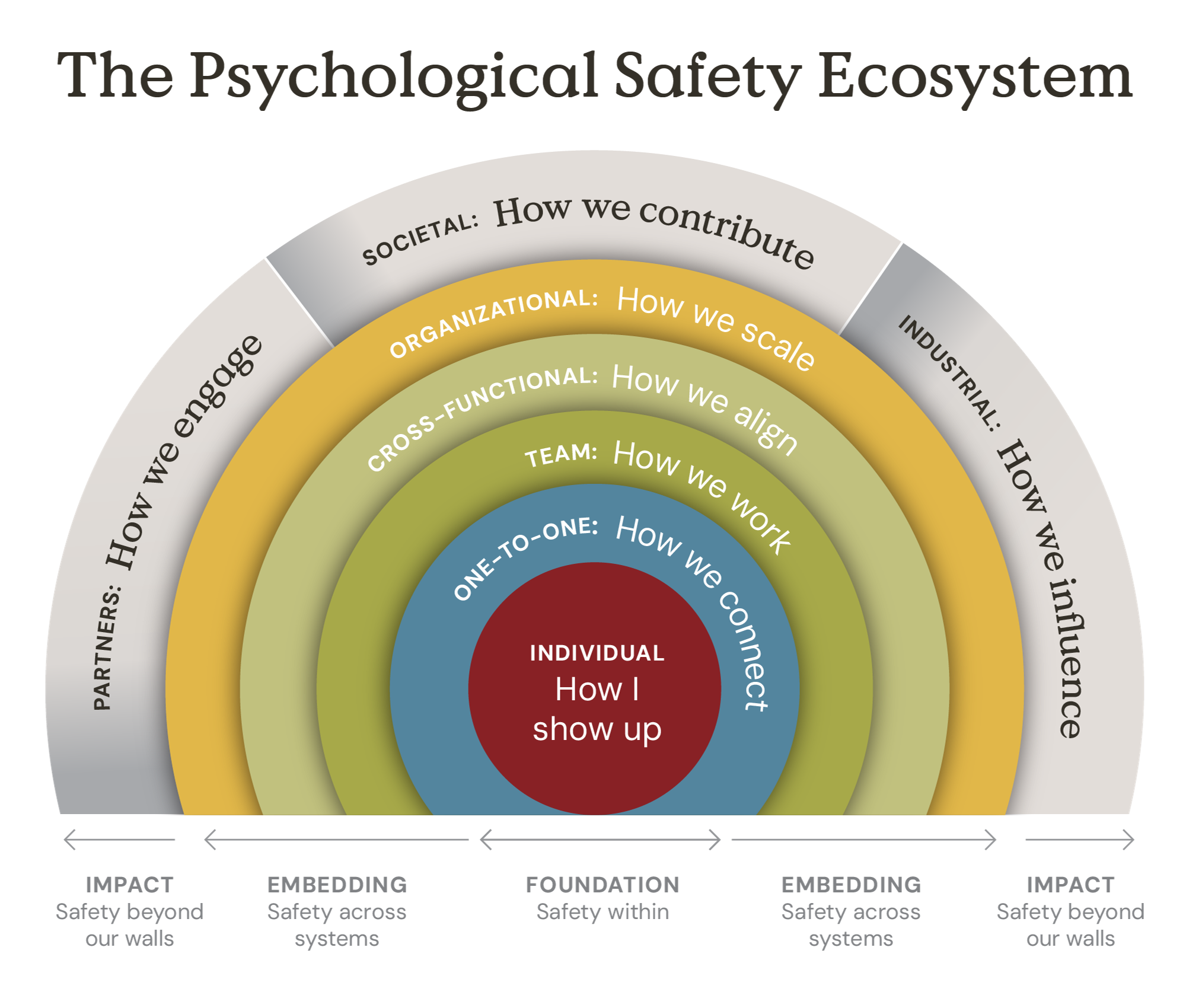
The Psychological Safety Ecosystem is built around eight contexts, each building on the last. Below, we’ll explain all of them.
Individual: How I show up
At the center is the individual context: the beliefs, emotions, habits and sense of agency each person brings to work.
Psychological safety here means people:
- Calmly notice what they think and feel
- Understand and consider their impact on others
- Feel safe, comfortable and confident enough to take responsibility for how they show up
When people are stuck in fight-or-flight, they spend their energy protecting themselves rather than doing their best work. Raise psychological safety and that changes fast – people take more ownership, make better decisions, and stay engaged when the pressure is on.
One‑to‑one: How we connect
The one‑to‑one context is all about interpersonal communication: manager to team member, peer to peer, mentor to mentee.
Psychological safety in this context shows up as:
- Clear, honest conversations rather than chronic ambiguity or avoidance
- Feedback given and received freely – people work with it, instead of bracing against it
- Strong relationship-building skills, and ability to repair relationships when something goes wrong
Much organizational dysfunction can be traced back to poorly-handled conversations. When clarity and respect become the default in one-to-one interactions, the effects spread, and everything else gets easier.
Team: How we work
The team context is how a group gets work done together, centering on shared goals, clear decision structures, and everyday rituals that drive collaboration.
Psychological safety in this context means:
- Established rituals for planning, checking in, and reviewing work
- Everyone knows who owns which decisions and where handovers sit
- Everyone has the chance to contribute; no-one is marginalised in meetings
- Regular space to talk about progress, pressures and what needs to change
When decision‑making and expectations are fuzzy, you see slow responses, confusion, and duplicated effort. When roles, rituals and team reflection habits are well‑designed, teams get more done, deliver to a higher standard, and continually improve how they work.
Cross‑functional: How we align
This context is where different teams interact – think cross-functional projects and day‑to‑day handoffs.
Psychological safety here is about:
- Different departments combining their perspectives and strengths, even when priorities differ
- Bringing trade-offs into the open, so people understand the rationale and can support the plan
- Teams inviting each other into key conversations, rather than throwing work over the fence
Many of the most expensive problems in large organizations – rework, missed deadlines, quality issues – stem from weak cross‑functional contexts. A hostile or political cross‑functional environment can drag overall performance down sharply. After all, complex systems are constrained by their most fragile link, not their strongest. Fix this context and you unlock gains that no amount of team-level work could reach.
Organizational: How we scale
The organizational context looks at how leadership is set up, how performance is managed, and how information flows across the business.
Key questions here include:
- How do we select leaders, support them, and hold them to account?
- Which behaviors and decisions reliably get rewarded, ignored, or penalised?
- Where do our policies and processes make it easier to do great work?
- Where do they get in the way?
When this context is well designed, it reinforces and solidifies positive behaviors at the individual, interpersonal, team, and cross-functional levels. This is about creating a climate where people can do their best work, day in, day out, without the need for constant firefighting or heroics.
Impact: How we engage, influence and contribute
The impact context is about thinking bigger than your own walls – how you engage with partners, how you influence your industry, and how you contribute to society.
In the partner context, psychological safety is about how you work with clients, customers, suppliers and contractors. High‑trust agreements, open communication and genuine input into how work is delivered mean issues can be surfaced and solved early, rather than hidden until they become costly. In safety‑critical and capital‑intensive sectors especially, this can be the difference between routine course‑corrections and expensive crises.
The industrial context is the sector environment you operate in – competitors, collaborators, regulators, unions, and shared standards. Here, psychological safety shows up in how incidents are reported and learned from, how people are treated up and down the supply chain, and how organizations collaborate to improve safety, quality and working conditions. When businesses model psychologically safe behaviour and help push higher standards, they don’t just shape a healthier industry; they strengthen their talent pipeline and reduce risk in their own operations.
The societal context looks at how your decisions ripple into wider communities. It includes the effects of your products and services on people’s lives, practices that impact families and communities, and the public stances and stories you put into the world. Organizations that take this seriously are better placed to anticipate regulation, maintain trust and avoid shocks. Together, these three expressions of impact define the footprint your business leaves in the world.
As we’ve shown, workplace culture is layered and complex. The Psychological Safety Ecosystem is the much-needed map for navigating it.
Businesses aren’t machines – they’re living things
We’d all love a dial marked “psychological safety” we can turn up or down, but reality is messier. We talk about the ‘ecosystem’ not only because this captures how multi-layered culture is, but because nature shows us how system-level change actually happens; how businesses survive and thrive.
In a business, small shifts in the individual and one‑to‑one contexts can have outsized impact, like a ‘butterfly effect’. When more people start taking the time to really listen to their colleagues, for example, that behavior can rapidly become the norm, especially when team and organizational contexts back this up. When a few managers start routinely asking “What do you need from me to make this easier?”, cross‑functional colleagues get looped in sooner, collaboration kicks in faster, and the whole business starts to feel more coordinated.
Natural habitats work as a whole system. Likewise in the workplace, improving already‑strong areas tends to bring limited benefit if a weaker link remains. You can have strong individual, one‑to‑one and team contexts, but if the cross‑functional context is political and hostile, performance still suffers. Importantly, leaders don’t need to transform every context at once – when we work with organizations to reset their cultures, we prioritize whichever context is doing the most commercial damage first.
Once you’ve identified the pressure points and made progress in those areas, you can widen the focus to organization’s long-term health. Resilience is the key concept here – the system’s ability to absorb shocks without flipping into a fundamentally different state. In the Psychological Safety Ecosystem, strong internal contexts (Individual through Organizational) give you shock‑absorption, and strong impact contexts (Partners, Industry, Society) give you supportive scaffolding. In a crisis, organizations with a healthy ecosystem don’t just survive; they emerge with better practices, stronger relationships, and a clearer sense of what they stand for.
A framework for culture change
Your task as a leader is to design and steward the system to improve the experience of work at all levels, for all employees, and for the benefit of the communities you’re a part of. Approached this way, psychological safety stops being an abstract ideal or isolated initiative – it becomes the north star for every decision, every project, and every partnership, powering profound performance gains. As always, we’re here to help.